Peer-reviewed articles, preprints and software papers. Conference abstracts and technical reports are listed in the CV. A complete, automatically updated list is on Google Scholar.
Summary
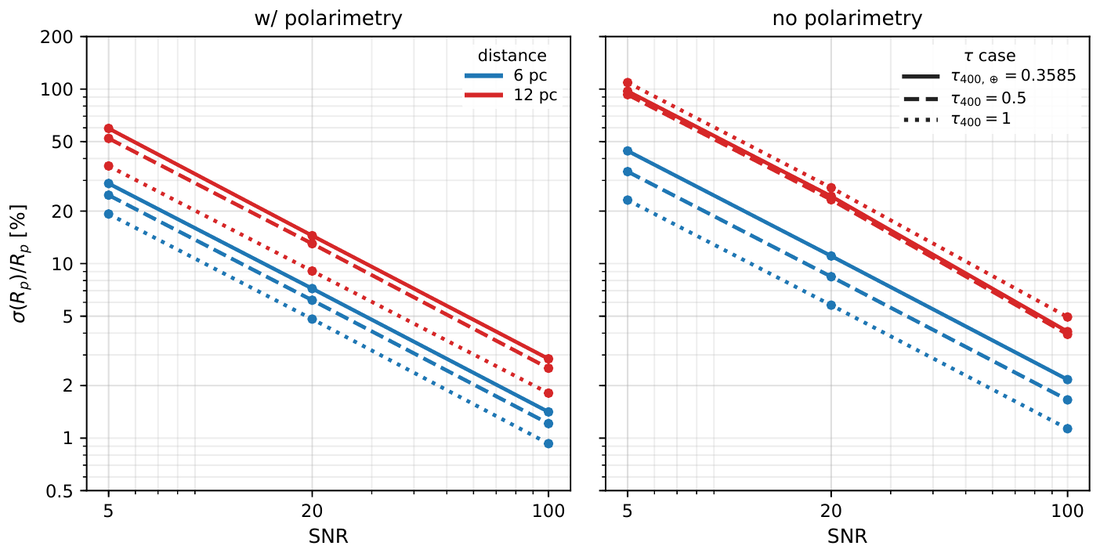
Brightness alone cannot distinguish a large, dark planet from a small, bright one. It constructs radius-independent observables: the normalized 400 nm lightcurve shape, ultraviolet intensity and polarization colors, and degree of linear polarization. In the 360–400 nm window, where Rayleigh scattering dominates and bright surfaces are nearly colorless, these constrain the atmospheric column, surface reflectivity and phases before the radius is inferred. With six epochs and unknown phases, median radius errors are 14 %, 3.2 % and 0.47 % at S/N 5, 20 and 100. This gives an observing path to radii of non-transiting HWO targets and argues for a window shortward of 400 nm.
Summary
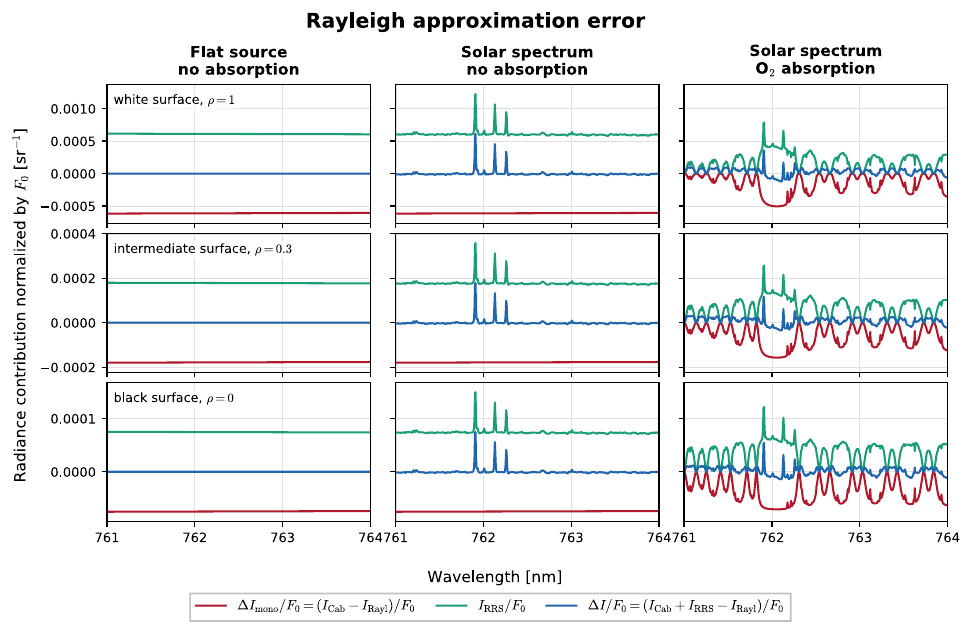
Models usually treat molecular scattering as Rayleigh scattering. This paper shows that this monochromatic approximation is biased where the spectrum is structured, because molecular scattering consists of elastic Cabannes and rotational Raman scattering. It derives the Cabannes single-scattering albedo and depolarization ratio of N₂, O₂ and air from Placzek's theory and resolves both components in vSmartMOM. For the O₂ A-band, used to constrain airmass in greenhouse-gas retrievals and by FLEX for fluorescence, it quantifies how the bias depends on surface brightness, pressure, geometry and aerosol and proposes a lookup-table correction. This matters for hyperspectral observations from the ultraviolet to near-infrared.
Summary
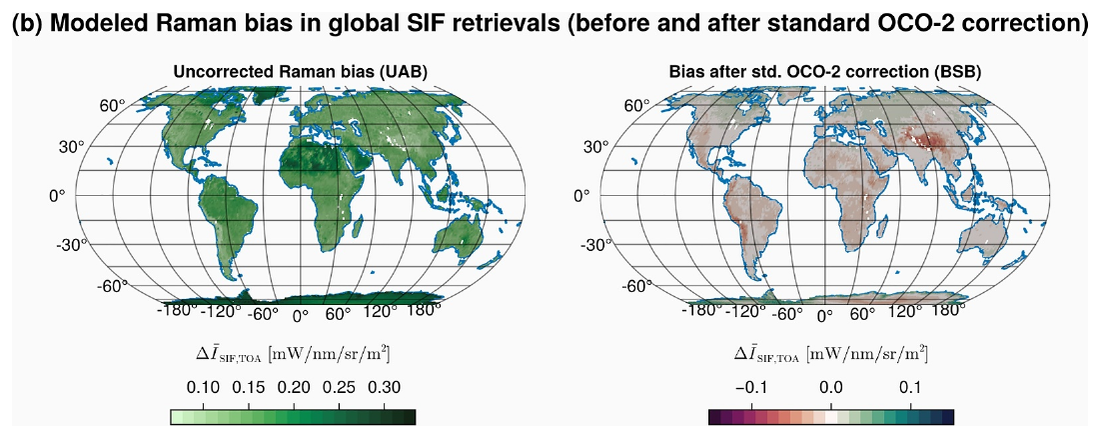
Solar-induced chlorophyll fluorescence (SIF) is retrieved from the filling-in of solar Fraunhofer lines, which inelastic (Raman) scattering of sunlight also produces. Polarized radiative transfer simulations of nadir observations near the O₂ A-band show that inelastic scattering causes spurious SIF of up to 0.35 mW m⁻² sr⁻¹ nm⁻¹ over vegetation-free regions such as the Sahara, Greenland and Antarctica. Zero-level offset corrections leave residual biases of about ±0.15 mW m⁻² sr⁻¹ nm⁻¹ that correlate with surface brightness, elevation and viewing geometry. A simulation-based lookup table subtracts the inelastic contribution; at publication it was being incorporated into the operational OCO-2/3 products. Red SIF retrievals (GOME-2, TROPOMI, FLEX) are most affected.
Summary
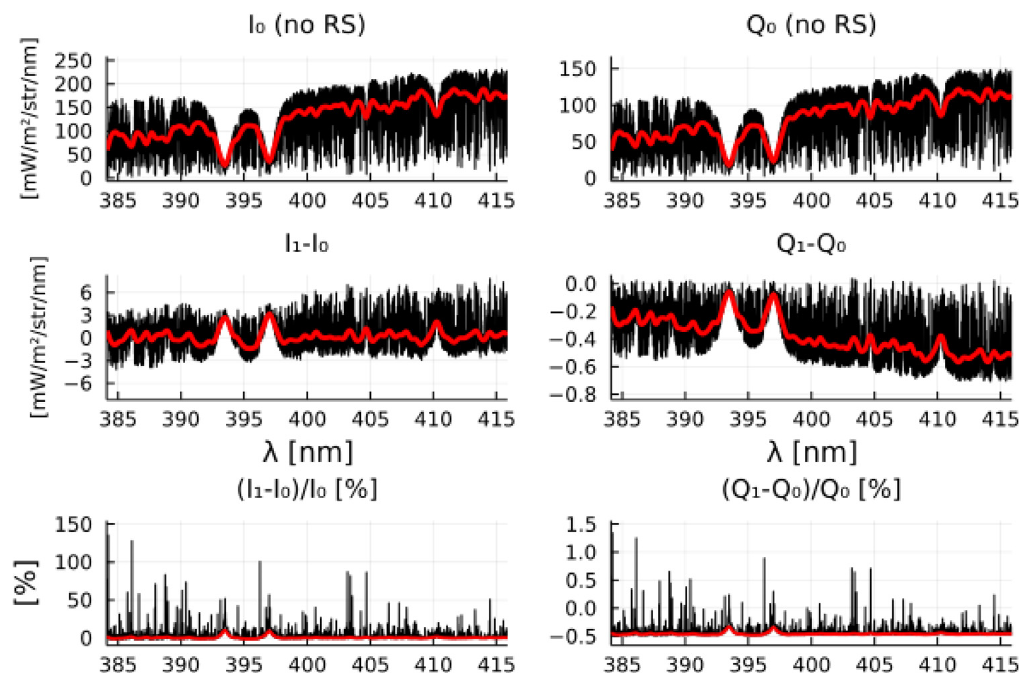
Building on Part I, this paper gives the radiative transfer formulation for fully polarized simulations of rotational, vibrational and rovibrational Raman scattering in the matrix-operator model vSmartMOM. The formulation is designed for GPUs, so that multi-wavelength inelastic computations need neither coarse spectral binning nor a single-scattering approximation. It is applied to Raman lidar returns, the Ring effect, Fraunhofer-line ghosting by vibrational scattering and inelastic filling-in of the O₂ A-band, confirming for the A-band that vibrational scattering is negligible and single scattering adequate. These full-Stokes, multiple-scattering simulations at high spectral resolution underlie the later SIF and Rayleigh-bias corrections.
Summary
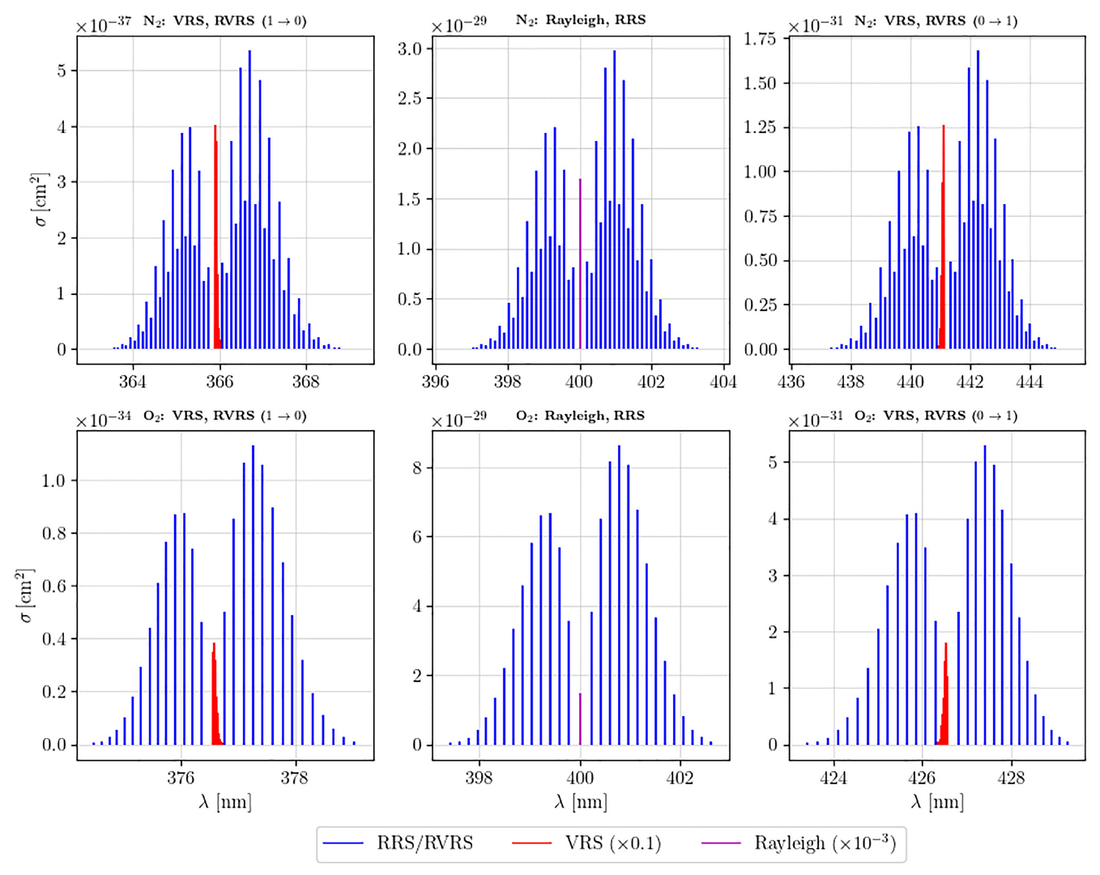
Raman scattering in the Earth's atmosphere is caused mainly by N₂ and O₂. Many molecular constants are needed, cross-sections and depolarization ratios differ between rotational, vibrational and rovibrational transitions, and the literature uses inconsistent notation. This paper unifies the formalisms of Long and Chandrasekhar so that Placzek's theory of molecular polarizability can be expressed through the cross-sections and scattering matrices used in radiative transfer, using Buldakov's simplified diatomic polarizabilities. It tabulates the constants, cross-sections and phase matrices of N₂ and O₂ on which Part II builds; the treatment transfers to atmospheres rich in diatomic species such as H₂ and CO.
Summary
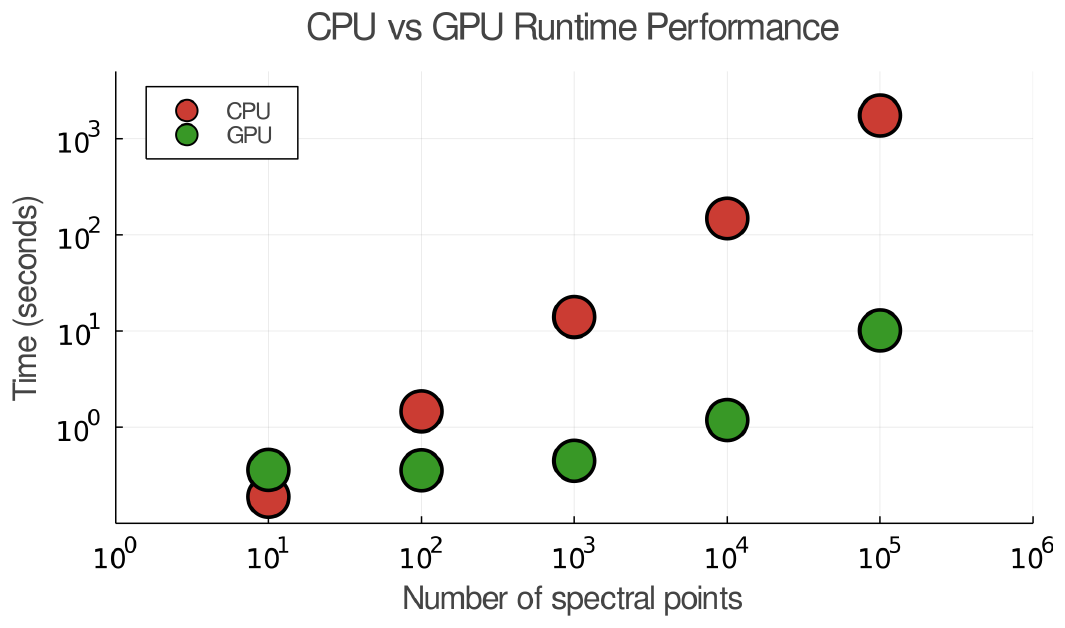
vSmartMOM.jl is an open-source Julia package for computing atmospheric optical properties and fully polarized, multiple-scattering radiances with the matrix operator method. Users set trace-gas profiles, aerosol size distributions and microphysics, surface reflectance and quadrature schemes; the absorption and scattering submodules can be used alone. Rather than porting legacy Fortran or C++ code, it was designed for CPUs and GPUs and for automatic differentiation, which provides Jacobians for spectral fitting. At publication it had been used for methane-plume simulation, aerosol profile fitting, brown-dwarf and exoplanet spectropolarimetry and graduate coursework; the later Raman, SIF and HWO studies build on it.
Summary
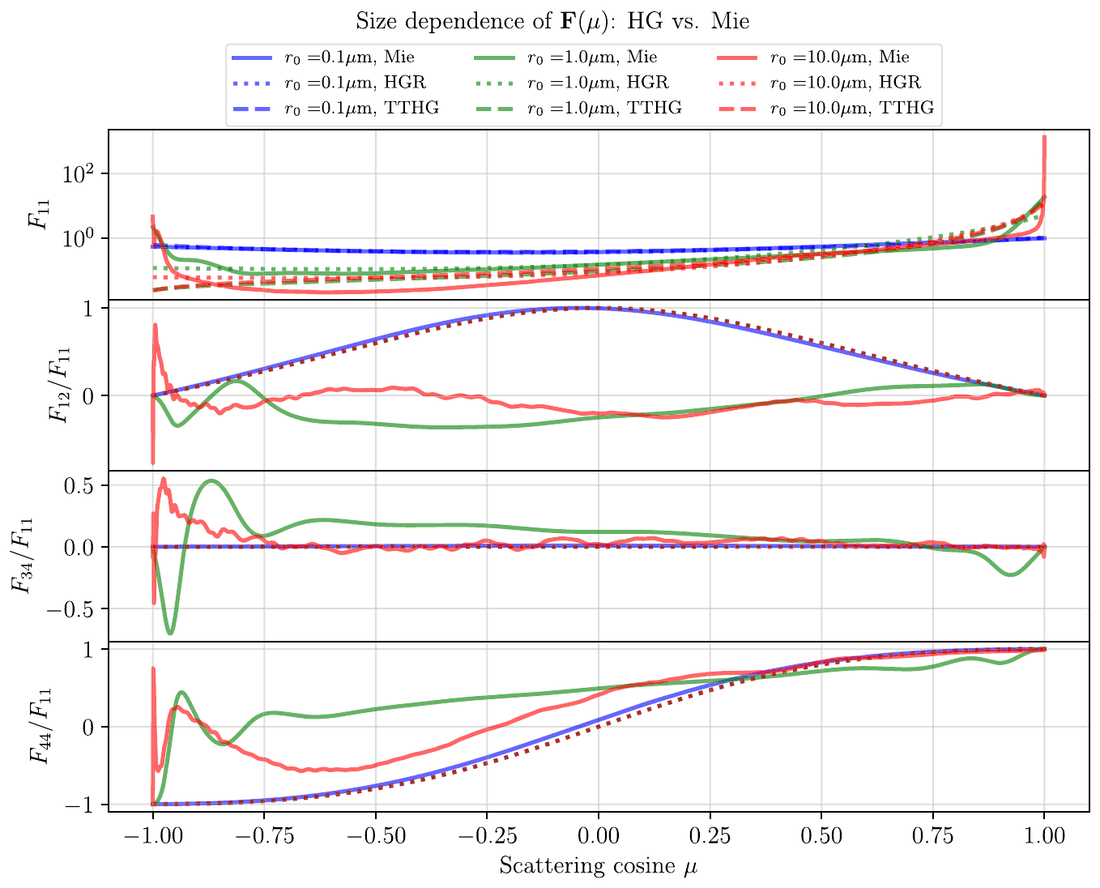
Direct-imaging missions and polarimeters like GPI and SPHERE observe starlight reflected by possibly cloudy exoplanets. It extends the semi-analytic 3D brown-dwarf framework to reflected light, using Mie theory for cloud and haze particles. The two-term Henyey–Greenstein and Henyey–Greenstein–Rayleigh (HGR) approximations blur phase-dependent lightcurve features and lose 10–39 % of the sensitivity to atmospheric parameters at S/N 5–500. HGR makes clouds as polarizing as Rayleigh scatterers regardless of droplet size, whereas real particles depolarize. With Mie scattering, polarimetry adds 10–30 % sensitivity; with HGR, almost none. Particle optics thus affect the interpretation of polarimetric data and the case for polarimetry on future instruments.
Summary
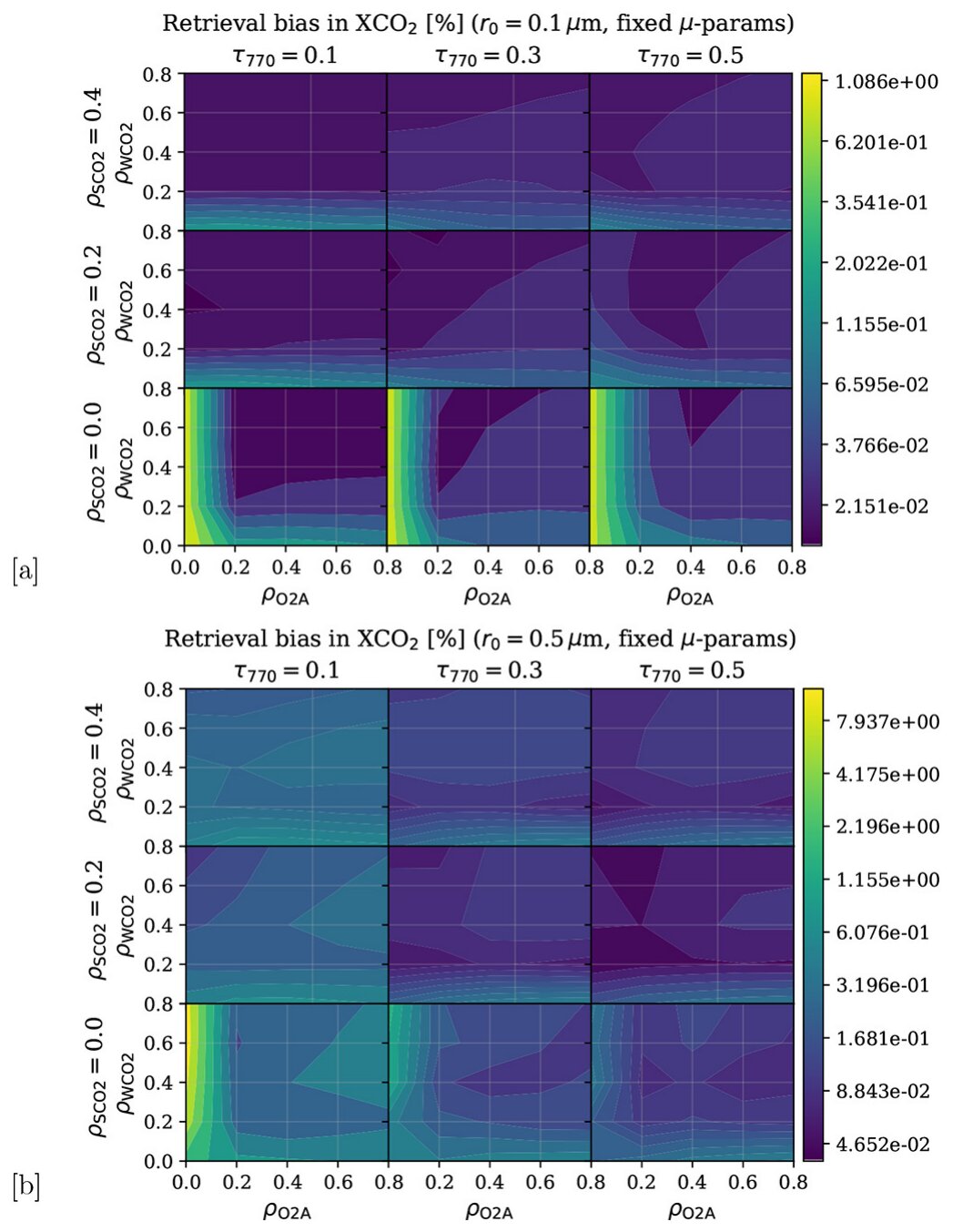
This paper analyzes how aerosols affect XCO₂ retrievals from OCO-2 and GOSAT. Simulated multi-angle spectropolarimetric observations in the O₂ A-band and CO₂ bands quantify the information on aerosol, surface and molecular parameters for different measurement combinations, with aerosol microphysics retrieved or fixed. The 0.2 % accuracy requirement is difficult to meet with intensity-only nadir measurements; multi-angle and polarimetric measurements reduce the uncertainty. Fixed microphysics can bias XCO₂ by 1–8 % at low aerosol optical thickness over dark surfaces, whereas retrieving it keeps biases negligible. The results favor multi-angle and polarimetric capability and retrieved rather than prescribed aerosol microphysics in future greenhouse-gas missions.
Summary
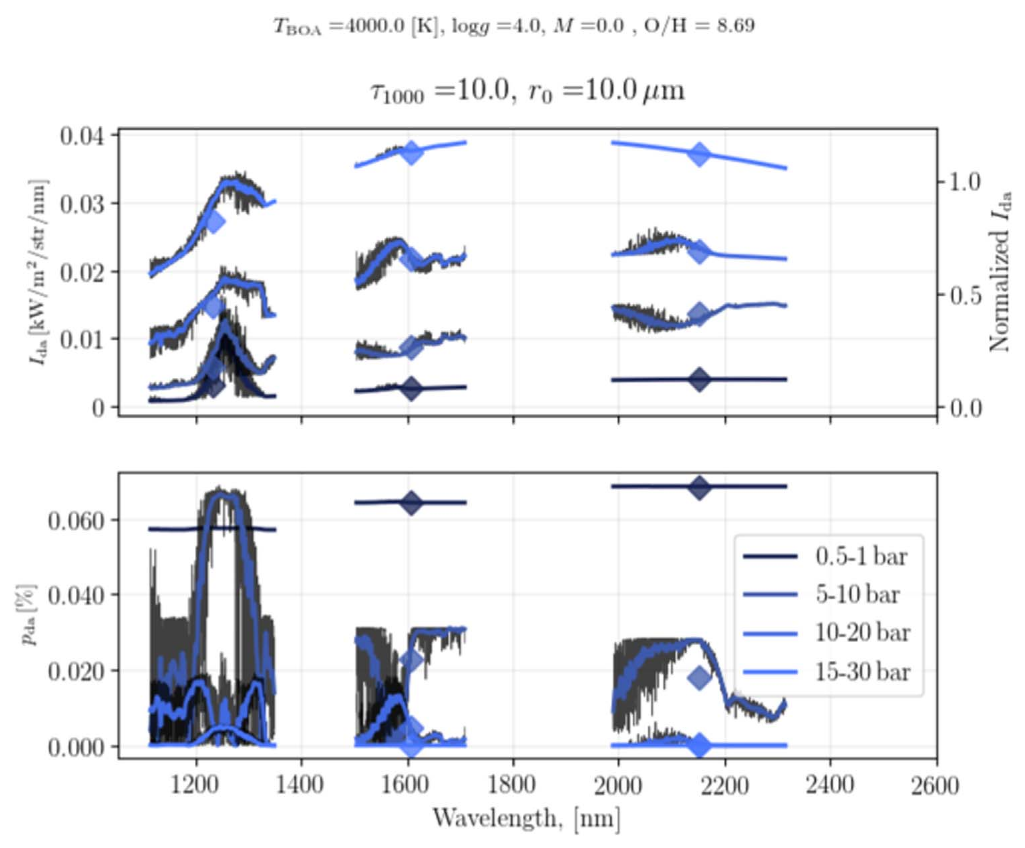
This paper adds molecular opacities to the conics-based brown-dwarf framework, so that the wavelength-dependent vertical structure follows from internal energy, gravity and metallicity. Polarized J, H and K spectra are computed for ranges of internal energy, gravity, cloud grain size and cloud depth. T dwarfs are fit more easily with cloudless atmospheres or high clouds; L dwarfs require deep clouds. Polarimetry adds information complementary to photometry; at current sensitivities it helps most for high, small-grained clouds. With Paper I it allows near-infrared photopolarimetry of L and T dwarfs to be interpreted in terms of cloud depth and grain size.
Summary
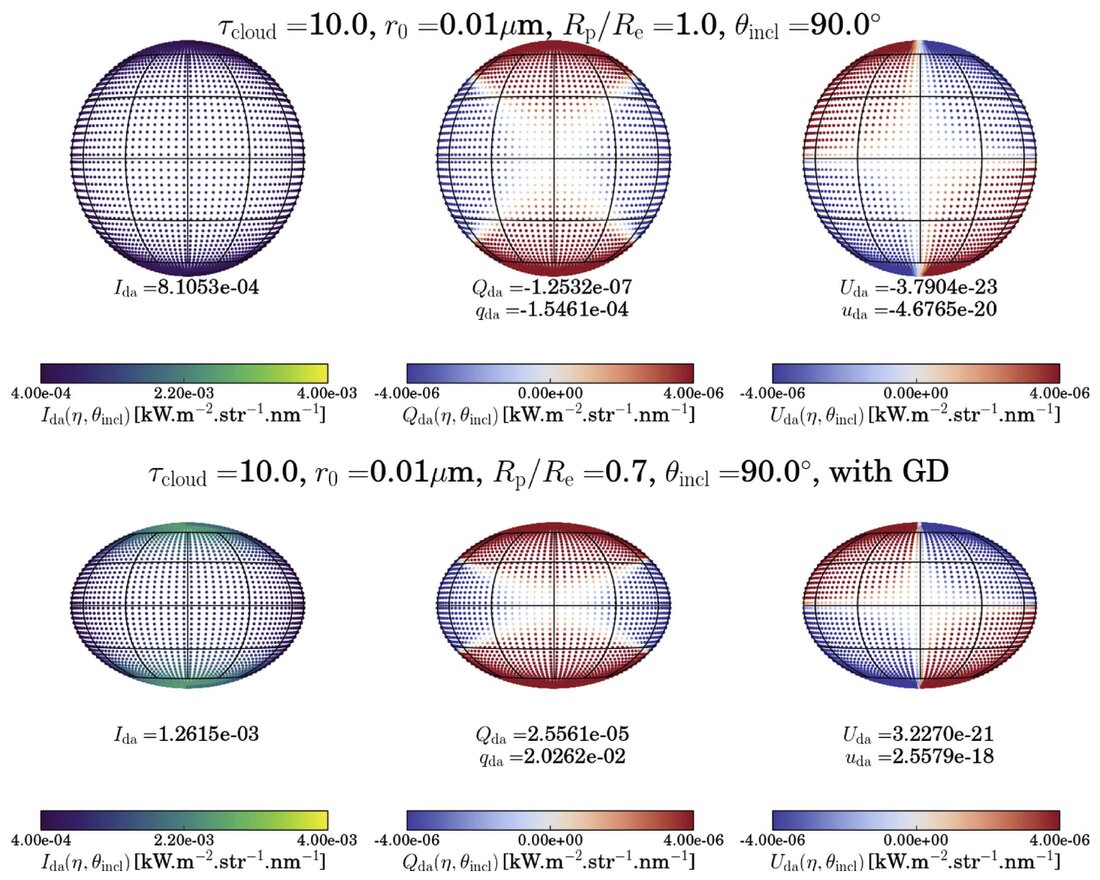
Brown dwarfs rotate rapidly and can be considerably oblate; scattering by electrons, molecules, haze or clouds polarizes their emission. It presents a conics-based scheme for the disk-resolved and disk-integrated polarized emission of oblate brown dwarfs and giant planets with uniform or patchy clouds. Polarization increases with oblateness and inclination and constrains the spin-axis orientation. Gravity darkening can strongly amplify it. For large cloud grains polarization drops sharply, so polarimetry also carries information on grain size. It provides an analytic basis for fast simulations of patchy clouds and temperature patterns on oblate bodies and underlies the later spectropolarimetric and reflected-light work.
Summary
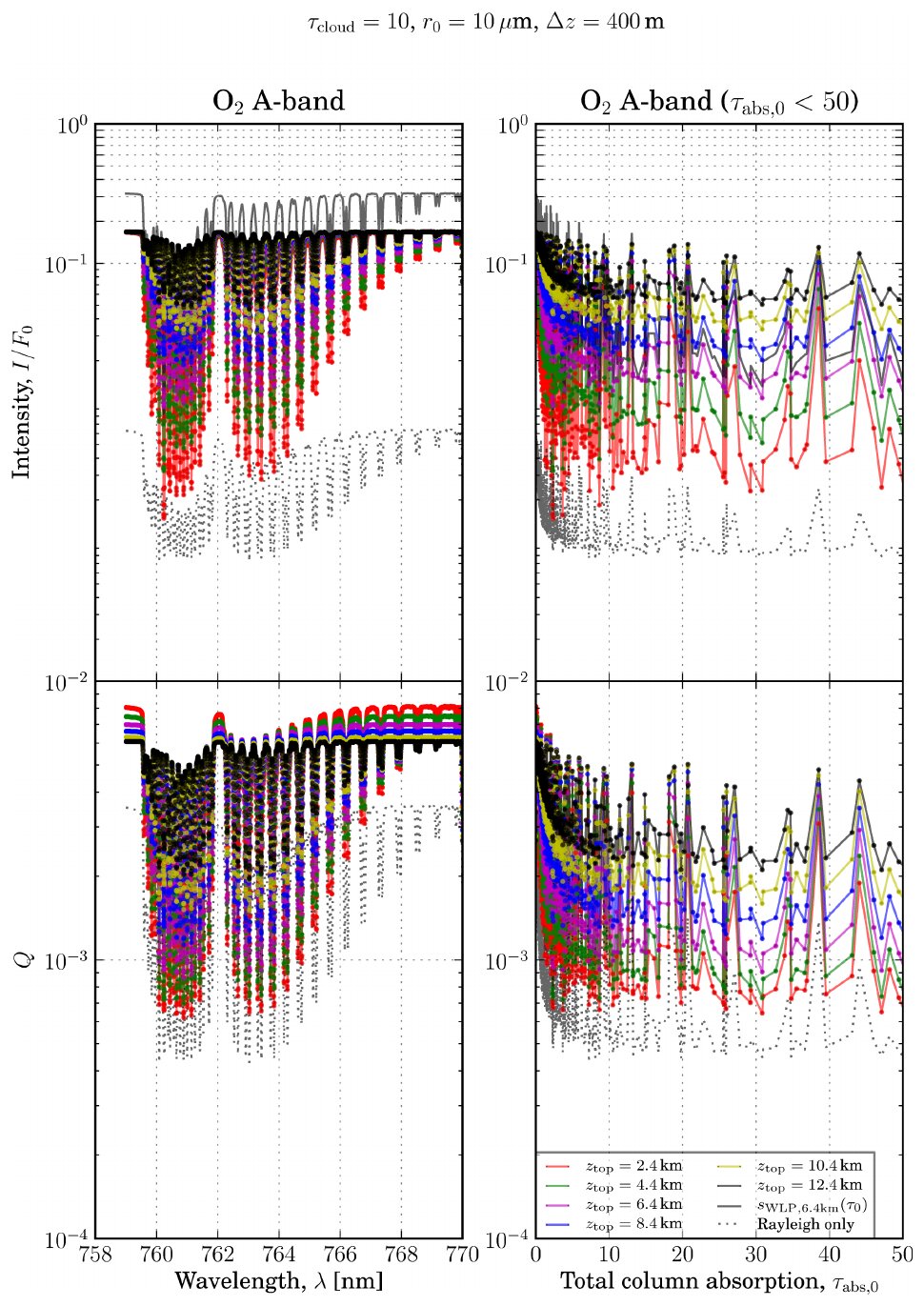
High-resolution O₂ A-band spectra from GOSAT and OCO-2 could allow cloud retrievals and reduce CO₂ airmass biases. This paper studies the polarimetric A-band sensitivity to cloud optical thickness, top height, geometric thickness and droplet size. Intensity best constrains optical thickness; cloud height and thickness are most sensitive at intermediate absorption strengths. Droplet size is best constrained outside absorption lines and from multiple angles, especially near the glory and rainbow. Because I and Q respond differently, two orthogonal components, as in GOSAT, carry more information than one. The distinct responses suggest simultaneous retrieval, with OCO-2 target-mode data constraining droplet size.
Summary
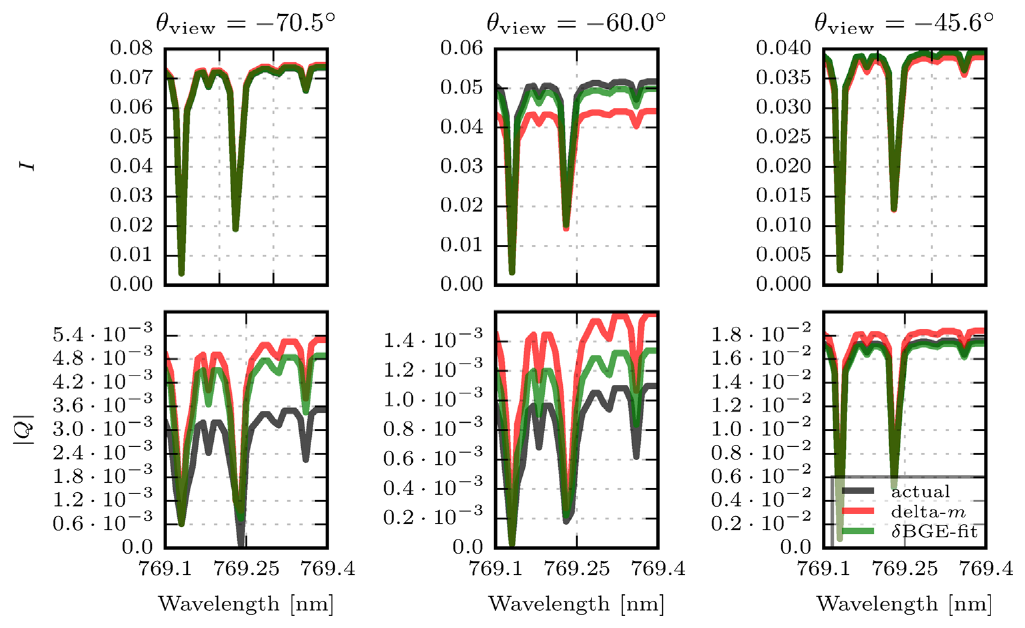
Cloud and aerosol phase functions need hundreds of Fourier components, which truncation reduces; few rigorous studies had covered the vector case. It derives the vector form of Wiscombe's delta-m method and identifies two error sources, delta-separation and phase-truncation error, largest near exact backscatter, a common satellite geometry. It adapts the δ-fit approach of Hu et al. to vector radiative transfer (δBGE-fit). For truncation at l = 25 of a phase matrix with over 300 components, δBGE-fit minimizes errors near backscatter and nearly removes them elsewhere. Truncation also distorts absorption line shapes, so δBGE-fit is recommended for XCO₂ retrievals from OCO-2 and GOSAT.
Summary
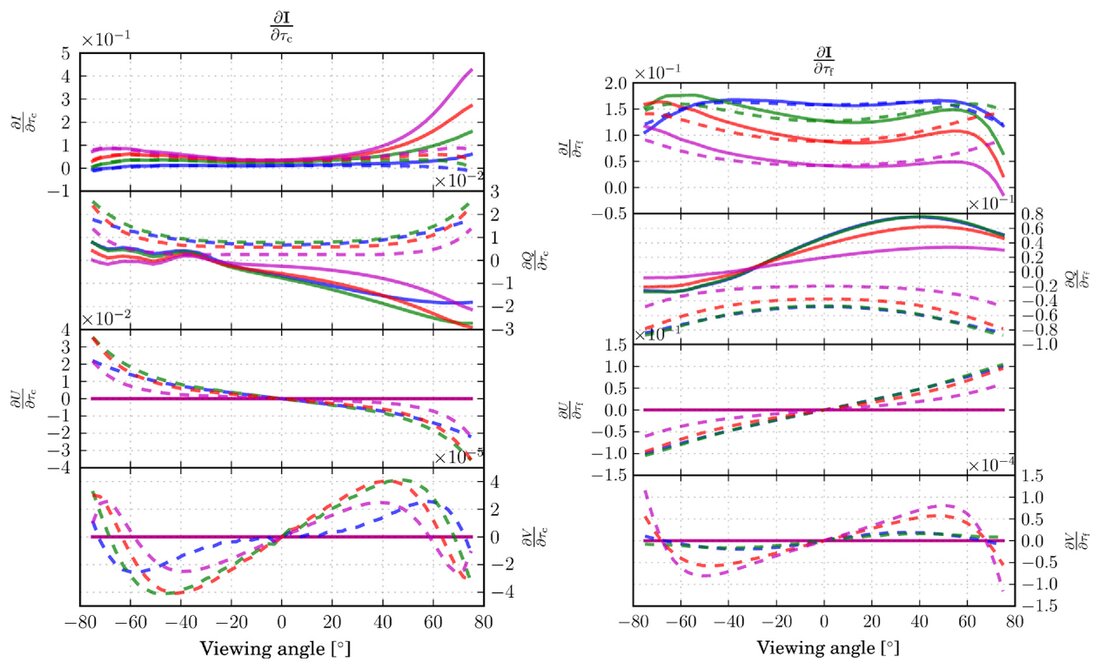
This paper extends the matrix-operator model smartMOM to polarized radiative transfer. Intensities are computed for the exact viewing geometry by ray tracing rather than interpolation, and vector delta-m truncation reduces the quadrature points and expansion coefficients needed. Against the Kokhanovsky et al. benchmark, Rayleigh-atmosphere Stokes parameters agree mostly to the seventh significant digit, and aerosol and cloud intensities within 0.05 % away from the forward peak. It is the first linearization of vector matrix-operator radiative transfer with respect to aerosol optical and microphysical parameters; its analytic Jacobians compare aerosol information in intensity-only and polarimetric data. It was later rebuilt as vSmartMOM.jl.
Summary
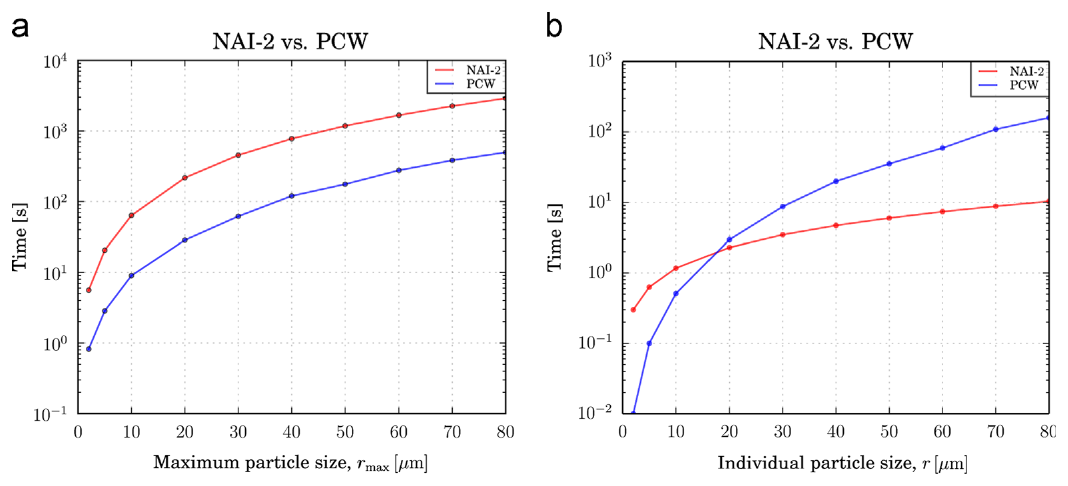
Computing Fourier moments of the Mie phase matrix is costly in aerosol and cloud modeling. The usual approach integrates the phase matrix numerically over angle; Domke (1975) proposed direct computation with Wigner 3-j symbols, but his main recurrence relation remained misprinted and the method was thought practical only below size parameter 120. This paper gives the corrected relation and an implementation with precomputed 3-j tables, accurate to machine precision. For polydispersions it is at least 6–8 times faster; for single particles numerical integration wins above size parameter 228. This makes Domke's approach practical for polydisperse aerosol and cloud scattering.
Summary
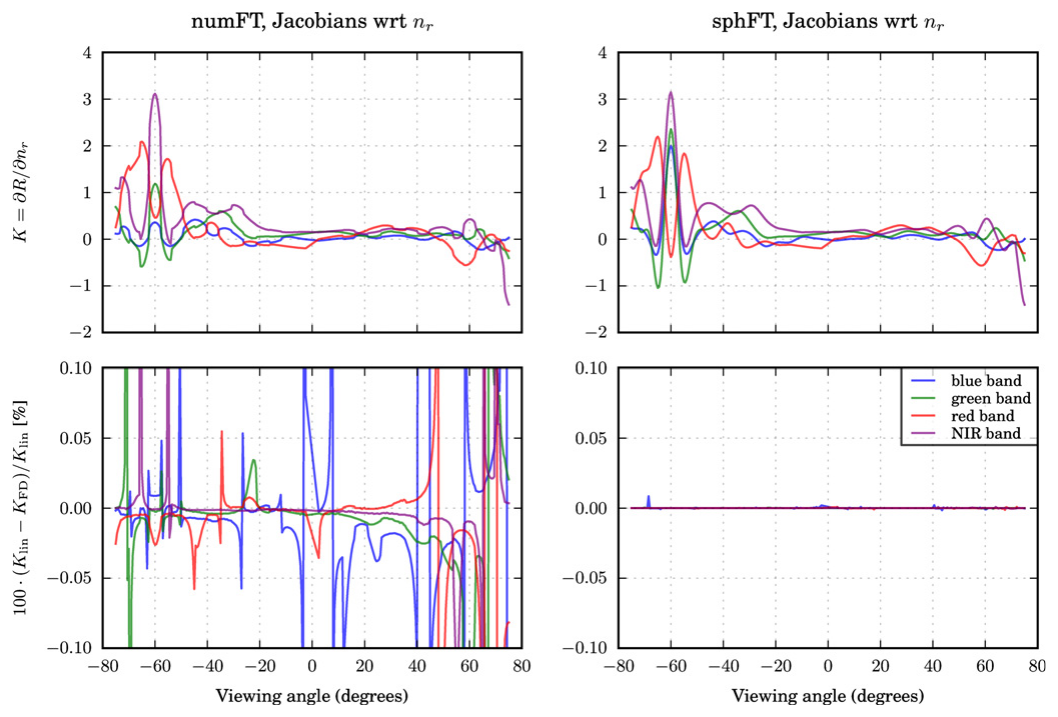
Multiple-scattering calculations need a Fourier decomposition of the phase function, by numerical transform or Legendre expansion. The numerical route interpolates between angles, and its error is hard to quantify from intensities alone. Analytic derivatives serve as a self-consistency test: analytic Jacobians are compared with finite differences in two otherwise identical linearized matrix-operator codes. Legendre expansion reduces the error by several orders of magnitude. For the numerical transform, error falls with angular resolution, so interpolation dominates; layers with several scatterers add a further error. The numerical transform should be avoided in favor of Legendre expansion, especially for peaked aerosol phase functions.
Summary
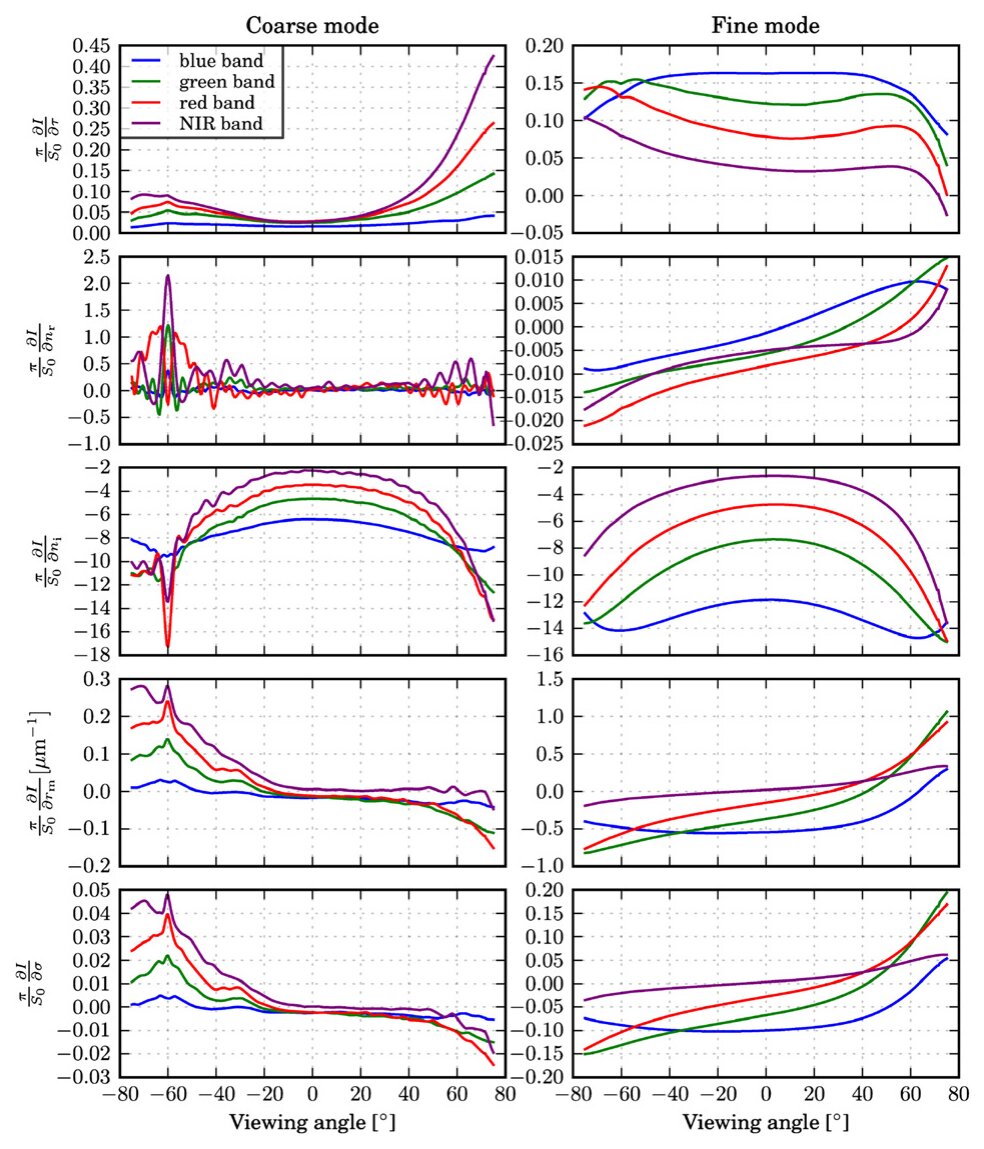
Optimization-based retrievals need the Jacobian matrix: the derivatives of the measurement with respect to retrieved parameters. This paper reviews the matrix operator method and derives analytic derivatives with respect to the optical thickness, refractive index and lognormal size distribution of a bimodal aerosol, and to Lambertian, modified Rahman–Pinty–Verstraete and Fresnel ocean surface parameters. The analytic Jacobians are verified against finite differences, which depend on step size, particularly for microphysical parameters. The speed advantage grows with the number of parameters, with parity for one parameter. This exact linearization makes optimal-estimation aerosol retrievals with matrix-operator models practical and underlies vSmartMOM.
Summary
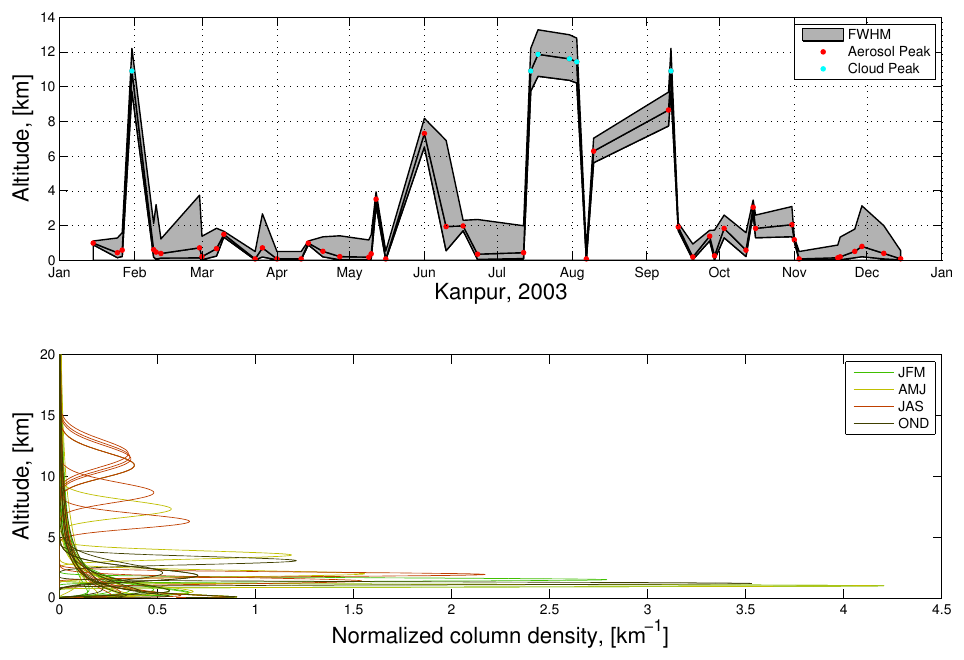
The O₂ A-band has long been used to estimate aerosol and cloud vertical distributions from space. This paper adds part of the B-band, also measured by SCIAMACHY, to an optimal-estimation retrieval of particulate optical thickness and lognormal vertical profile over bright and dark surfaces. Information-content analysis shows the B-band adds vertical information, because its absorption strength and surface albedo differ from the A-band's. Applied to Kanpur in 2003, retrieved monthly optical thicknesses correlate with AERONET (r = 0.92, non-monsoon months). Radiometric uncertainties and computational cost limited application to this case study, which nevertheless showed a stable, physics-based aerosol-profile retrieval from SCIAMACHY alone.
Summary
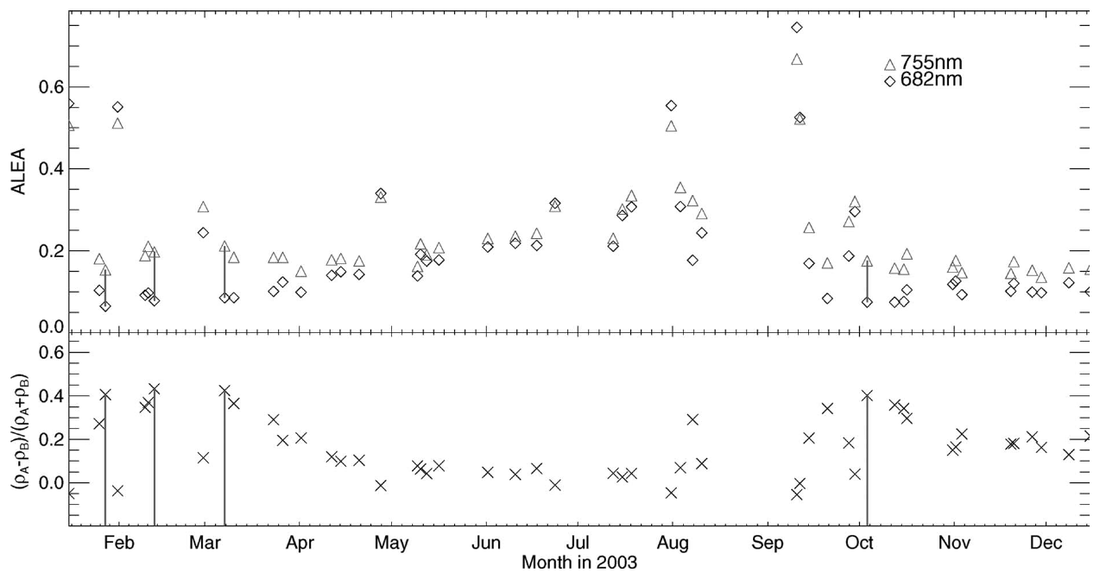
This paper identifies clear-sky scenes in a satellite time series over a pixel with unknown albedo and aerosol type. Reflectance does not vary monotonically with aerosol loading, so observations cannot simply be ranked by it. Treating each observation as aerosol-free, the relative contrast between the resulting Lambertian equivalent albedos at two wavelengths of different surface albedo varies monotonically with aerosol. Applied to SCIAMACHY data over a non-dark surface, it is validated against measured and modeled O₂ A- and B-band absorption. Independent of surface brightness and aerosol type, it applies across instruments; the 2012 SCIAMACHY retrieval confirmed its premise.